
Conjuring Care While Healing
Reflections and notes on how we're all still arriving amid (dis)possession and grief.

I'm absolutely in a season of receiving as much as I give.
And if I'm being honest, this should have happened sooner. So much of what's coming up, as I sit with grief as a long-time teacher, is how much capacity I do not have. There's so much collective and individual grief before attending to other losses, and I'm reminded of some of the original throughlines of my work - community care and healing justice.
I'm grateful to my friends and family who have seen and held me through all the highs and lows over this past month and even this past year. As someone who soldiers through a lot because it needs to be done, I get visits from my aunt, who reminds me not to borrow any more trouble.
During my time at the Spring meeting of the APA Division 24 conference, I was invited to really sit with the realization that so much of ancestral healing is impacted across generations through institutionalization. I thought of my grandmother, who, as a child, saw and heard some of our ancestors clear as day, as if they were in the room. Now that one of my aunts has started her ancestor journey, I still hear her voice and the sound of her footsteps coming around the corner. She’s looking for her coffee, which is mainly a splash with a knock-off version of Baileys Irish Cream as the star of the show. She’ll get her own separate reflection on here, but in the meantime, I had to mention her here because she was absolutely sitting in on my session at the conference.
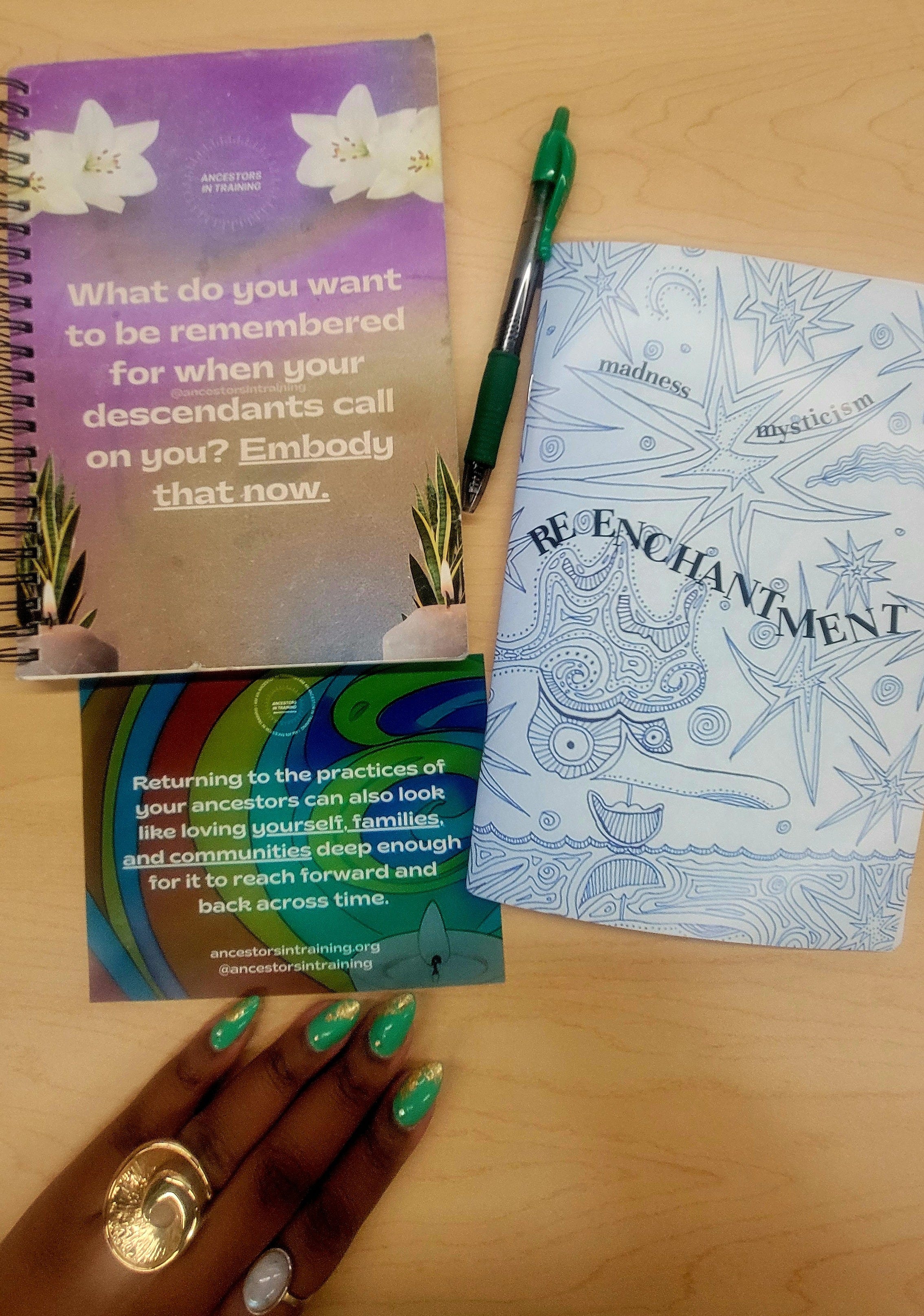
Legacy work is care work is sacred work.
And that sense of otherworldly knowing or sense that has been passed down to me, and deepened through my own ancestral veneration practice - previously could have had me institutionalized if I lived in another time period. Maybe one that’s not that far off either. This realization reminds me of what my grandmother shared, as well as invites me to think of how the continued violence, extraction, and numbness that we are inundated with leads to a dispossession of our highest selves - all so that we may be possessed by the horrors of late-stage capitalism.
Grief as initiation is also reminding me of what one of the keynote speakers, Bayo Akomofale, gifted us with - the idea of still arriving. A storyteller, he debuted a gorgeous story that has stayed with me since, quickly entering my lexicon. The idea of still arriving, and that it makes time for us to arrive whole.
To paraphrase Wu-Tang and call back to Bayo, I’m trying to survive and thrive on arrival.
A video is making the rounds on my social media that says that Black women experiencing weathering make us age biologically much faster than our counterparts. I pause, and think back to how much of the dominant Western hyper capitalist structure benefits from us rushing through and not tending to the myriad of emotions that we feel. One that encourages us to bottle things up and swallow them. But now, as science catches up to the ancients, what will we do with that knowledge?
My aunt would take it as a confirmation of why it’s important to let things go. That, in the end, it’s not worth it to hold on to so much of that hurt - but instead to find spaces, resources, and practices that can let you fully arrive. A participant during my session at the conference asked:
“What degrees of survivor’s guilt do you experience doing this work?”
I paused then, too. It was something I had never consciously considered, but in hindsight, I may have said in other forms. It is truly a privilege to regard oneself as an ancestor in training and to move accordingly. To be grounded in lineages of care, tend to diasporic memory, and find ways of living our legacies in real time means that we also come from folks who did not get a chance to do so while they walked the Earth. It’s similar to the work of QTPOC Mental Health’s Rest for Resistance and The Nap Ministry, who both advocate for us to rest for those in our lineage who could not do so.
Unearthing stories and tending to them with care, or even witnessing our family and loved ones’ curiosities about what we call healing, is an offering in and of itself. But it is also heavy lifting. It asks us to dig deep, listen, and be a mirror to our elevated ancestors and our elders who are healing through the work that we set out to do. I’d like to think that every time we commit to our own healing, generating new legacies and breaking harmful cycles - the ancestors whisper to our descendants, “this is what you have to look forward to. This is what’s possible.”
This excavation work requires that we stay anchored as well, and I think that ensuring that we have a political or organizing home that makes room for our ancestral traditions is a site of possibility. What did your elevated ancestors stand for? What did their navigating the challenges of their times look like, and is there any wisdom that you can carry forward? In revolutions of the past, as I learned from my co-presenter Chinyere, freedom fighters like Nat Turner looked to nature for signs that it was time to rebel. The eclipse that he saw then still casts a shadow over Black Diasporic folks, as so much of the backlash to that resistance can creep in when we feel disconnected from our collective and individual power. In Candomble ceremonies, the word for what we may say in English as ‘possessed’ translates to ‘incorporação’ - and I think that Brazilian Portuguese’s framing is a more embodied way of considering how we fill ourselves up with the information, energy, politics, etc, that we consume. It invites us to reclaim the very things that make up who we are, and purge what was placed on us without our consent. Reclamation here can take many forms, too.
It’s homemade Florida water to calm your nerves before entering a space
It’s distilling and naming how you want to be remembered in a world that benefits from you forgetting.
It’s allowing yourself to be witnessed just as much as you are called to do the same for others.
Divining my present location on the grief and gratitude axis has looked like a reclamation of what it means for me to be full of myself in a way that does not allow for other harmful narratives, doubt, fears, or any of the -isms, to take root in my spirit. It’s sitting with how many of our ancestors may have been considered evil because they had a deeper relationship with nature. One culture’s mystic is another person’s fear made flesh. But the scariest thing for me would be to allow myself to be seen and held by my family, chosen communities, and my ancestors - in the name of keeping up with some external idea of who I’m supposed to be.
As future ancestors, we have to become comfortable with excorising the ghosts of these decaying systems, so that we can greet the worlds we desire with open arms.